
Social Security in 2026: Smart Claiming Decisions and What the Headlines Really Mean
By Brian Cain · Jun 23, 2026

For most retirees, Social Security is the foundation of their income: guaranteed, adjusted for inflation, and paid for life. When to start it is one of the few retirement decisions fully in your control, and the difference between a rushed choice and a planned one can add up to six figures over a lifetime. Meanwhile, headlines about the program “running out” keep people anxious. This paper sorts fact from noise.
The short version
- Social Security isn’t going away. Even in the worst projections, workers’ payroll taxes keep funding most scheduled benefits. Congress has a history of acting before the deadline.
- Your claiming age sets your check for life. Starting at 62 can mean a check about 30% smaller than waiting until full retirement age. Waiting until 70 can mean a check about 24% larger.
- Married couples should plan together. The higher earner’s claiming age often decides how much the surviving spouse lives on.
- Public employees, take a second look. A 2025 law eliminated the rules that used to cut benefits for many teachers, police, firefighters, and other workers with non-covered government pensions.
- “Earliest” isn’t always “worst,” and “latest” isn’t always “best.” The right age depends on your health, your spouse, your other income, and your taxes.
The headlines: “Is Social Security running out?”
No. Here’s what the reports actually say.
Social Security is funded mainly by payroll taxes from today’s workers, with a reserve (the “trust fund”) covering the gap when benefits exceed those taxes. Each year the program’s trustees publish a projection. Recent reports have estimated the retirement trust fund could be used up in the early-to-mid 2030s.
If that happened and Congress did nothing, payroll taxes would still keep coming in. Those taxes would cover roughly 75% to 80% of scheduled benefits. That’s a real cut and worth planning for, but it is very different from “nothing.”
Congress has faced this before. In 1983 it passed a package of changes just months before benefits would have been affected. Possible fixes this time include raising the payroll tax cap, adjusting the retirement age, or changing how benefits grow. We can’t predict which path lawmakers will take.
What we do about it: We plan with the benefits you’re scheduled to receive, and we stress-test your plan with a reduced benefit. If your retirement still works with a smaller check, you can tune out the headlines.
Trust fund projections change each year.
Claiming age: the decision you control
You can start Social Security as early as 62 or as late as 70. For anyone born in 1960 or later, full retirement age is 67. Every year you wait, up to 70, your monthly check grows, and that larger check is adjusted for inflation for the rest of your life.
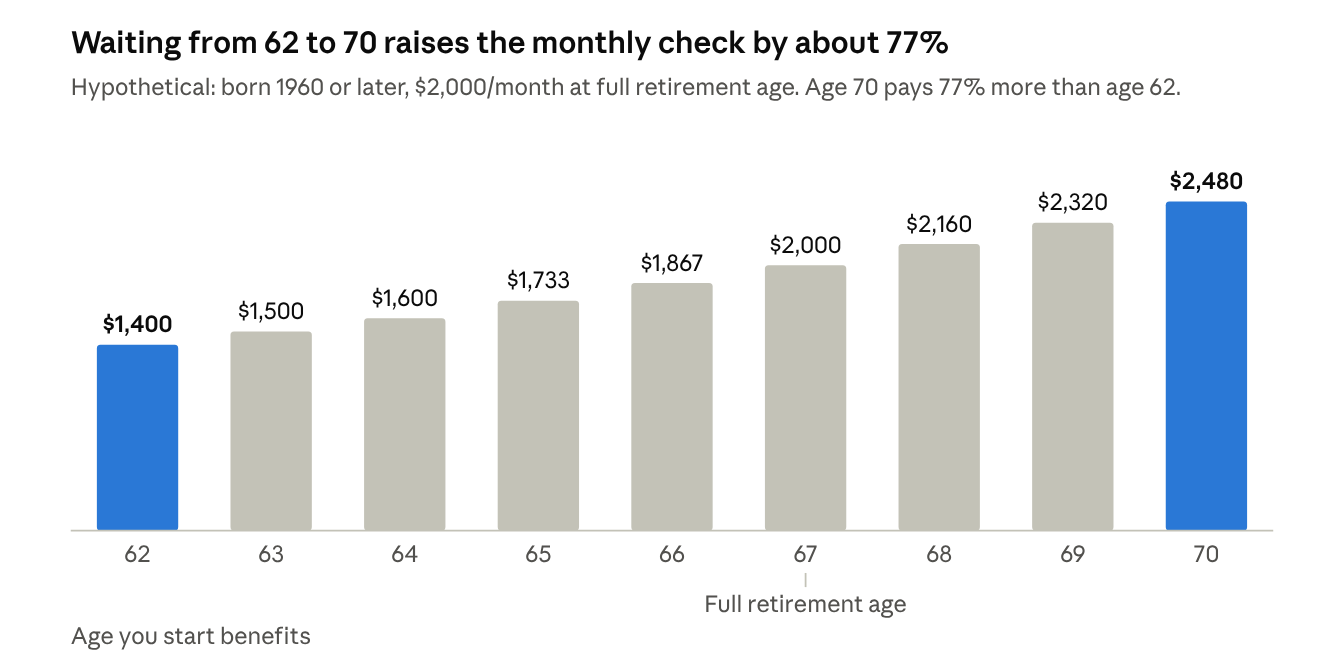
Hypothetical illustration based on Social Security’s published reduction and delayed-retirement credit rules for full retirement age 67.
Waiting isn’t automatically right. Someone in poor health, without other savings to bridge the gap, or who needs the income now may be better served claiming earlier. Someone healthy, still working, or married to a lower earner often benefits from waiting. The “break-even” point between claiming at 62 and 70 typically falls around age 80 to 82, so your health and family history matter.
Married couples, survivors, and public employees
Spousal benefits. A spouse can receive up to 50% of the other spouse’s full-retirement-age benefit, if that’s more than their own. Spousal benefits don’t grow by waiting past full retirement age, so there’s rarely a reason for the lower earner to delay beyond it.
Survivor benefits: the most overlooked part of the decision. When one spouse dies, the survivor keeps the larger of the two checks, and the smaller one stops. That means the higher earner’s claiming age effectively decides the survivor’s income for the rest of their life. Delaying the higher earner’s benefit is often less about the couple and more about protecting whoever lives longer.
Divorced? If your marriage lasted at least 10 years and you haven’t remarried, you may qualify for benefits based on your ex-spouse’s record without affecting theirs.
Public employees: a major change in 2025. The Social Security Fairness Act, signed in January 2025, repealed two rules (the Windfall Elimination Provision and the Government Pension Offset) that reduced Social Security for many people who also receive a pension from work not covered by Social Security. That includes many teachers, police officers, firefighters, and other public workers, especially in Illinois systems where public employees often don’t pay into Social Security.
If you or your spouse were affected, your benefit may have gone up, and you may now qualify for a spousal or survivor benefit you were told you couldn’t get. If you were turned away in the past, it’s worth checking with Social Security again.
Working while collecting, and taxes on benefits
The earnings test. If you claim before full retirement age and keep working, Social Security temporarily holds back $1 for every $2 you earn above a limit (about $24,480 in 2026). In the year you reach full retirement age, the limit is higher (about $65,160) and the holdback is $1 for every $3. Withheld benefits aren’t lost: your check is recalculated upward once you reach full retirement age. After full retirement age, there’s no limit at all.
Taxes on benefits. Depending on your other income, up to 85% of your Social Security can be subject to federal income tax. The income thresholds that trigger this ($25,000 single, $32,000 married) have never been adjusted for inflation, so more retirees cross them every year. Indiana and Illinois don’t tax Social Security benefits.
This is where Social Security planning and tax planning meet. Drawing from IRAs, taking a pension, or doing Roth conversions in the same years you collect can change how much of your benefit is taxed. Sequencing these sources is a big part of what we do.
2026 figures are approximate.
How Viribus can help
Social Security rules are public, but how they apply to your household isn’t obvious. We look at your earnings record, your spouse’s, your pension or 401(k) plans, and your tax picture together, then show you how different claiming ages play out over your lifetime and your survivor’s.
A Social Security review with us can include a side-by-side comparison of claiming ages for you and your spouse, survivor-income scenarios, a check on whether the 2025 public-employee rule change affects you, and a plan for coordinating benefits with your other income and taxes. We’ll explain the reasons behind every recommendation and any costs involved.
Next step: Call our Terre Haute office or visit viribuswm.com to schedule a review. Bring a copy of your Social Security statement (available at ssa.gov/myaccount) and your spouse’s, if married.
Important disclosures
This material is for educational purposes only and is not a recommendation for any specific individual. Social Security rules, benefit amounts, and annual limits change; figures shown are approximate and based on information available at the time of writing. Confirm your benefits with the Social Security Administration. Viribus Wealth Management &Partners is not affiliated with or endorsed by the Social Security Administration or any government agency, and does not provide legal or tax advice. Please consult your tax professional or attorney regarding your situation.
Securities and advisory services offered through &Partners, LLC, a registered broker-dealer and investment adviser, member FINRA/SIPC. Fidelity Investments, through National Financial Services LLC, serves as custodian.